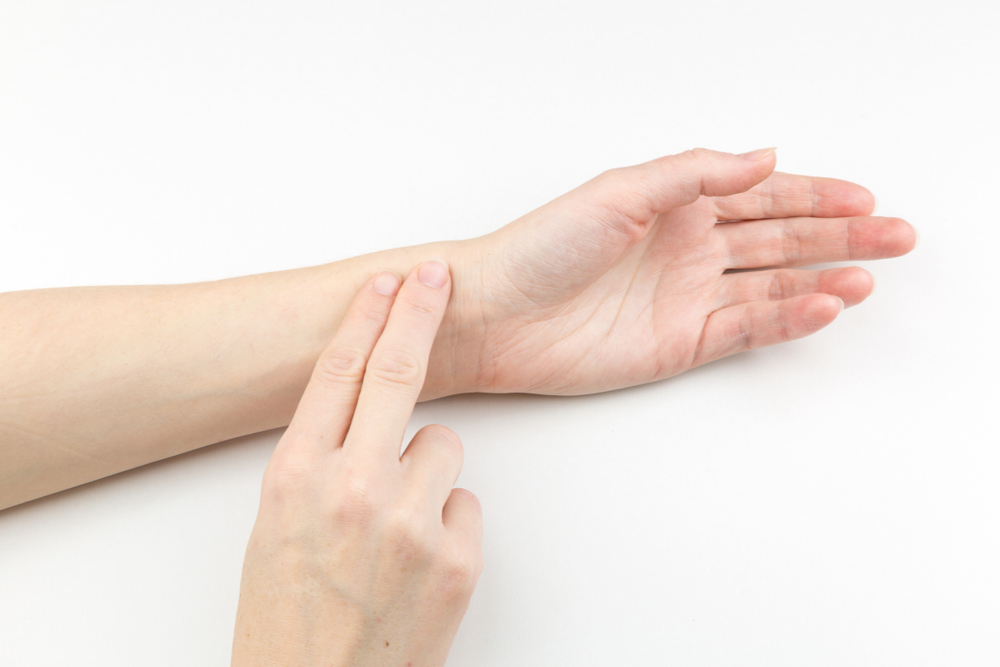


What is oxygen saturation?
Oxygen saturation, often referred to as "O₂ sats", or "SpO₂" is a measure of how saturated our blood is with oxygen. It is often considered as the 'fifth vital sign' or core observation.
(More technically, a measure of the percentage of haemoglobin - an oxygen-carrying substance in our blood that is bound to oxygen).
Why is oxygen saturation important?
Oxygen is the fuel required for almost everything our bodies do. Without oxygen, our vital organs shut down and serious damage can happen within a few minutes of oxygen deprivation.
When oxygen levels are low in the blood (hypoxaemia), we may start to experience symptoms such as:
- Shortness of breath
- Rapid and shallow breathing
- A fast heart rate which might feel pounding
- Irritability and confusion
- Changes in skin colour to blue/grey (cyanosis) when severe
What is considered a normal oxygen saturation level?
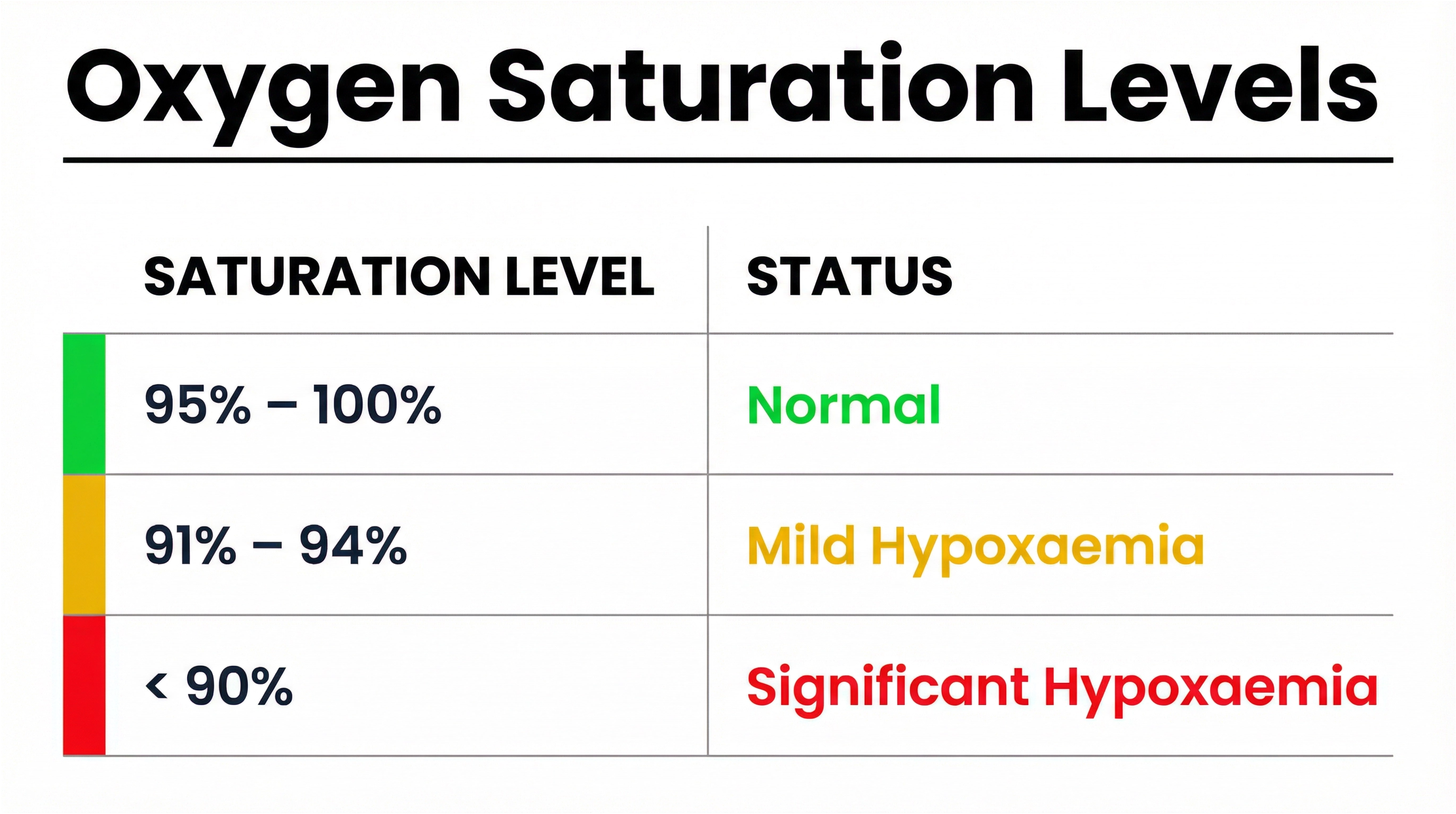
- At sea level, it is generally accepted that normal oxygen saturations range from 95 to 100%
- Oxygen saturations may be lower at higher altitudes
- Persistent oxygen saturations <95% may be associated with an intercurrent illness
- Persistent oxygen saturations <92% usually require further investigation for lung disease
- Values <70% are life-threatening
However, there are certain medical conditions where baseline oxygen saturations are accepted to be lower, for example in chronic obstructive pulmonary disease (COPD) where the acceptable range generally sits from 88-92%.
How do you measure oxygen saturation?
Oxygen saturations can be measured with a medical device called a pulse oximeter, which is commonly clipped onto the finger (but sometimes toes or earlobes if access to fingers is difficult).
A light emitted from the pulse oximeter passes through the finger and is picked up on the other side by a photodetector, measuring the amount of light absorbed. This feeds into a computer algorithm which uses this information to calculate the oxygen saturation that displays on the device.
Because the signs and symptoms of low blood oxygen may not always be apparent until oxygen levels drop very low, pulse oximetry is invaluable in early detection of hypoxaemia and used widely in the medical setting. Using a pulse oximeter is also painless and non-invasive, which makes it accessible for home use.
In the hospital setting, oxygen saturations can also be measured with a special blood test called an arterial blood gas (ABG) which is usually taken from the wrist or groin.
A number of things may affect the accuracy of a reading from a finger including:
- Fingers being too small for the probe (usually babies and children)
- Finger deformities (due to injury or medical conditions such as rheumatoid arthritis)
- Cold fingers or poor circulation
- Excessive sweating or motion preventing a good connection
- Nail polish/varnish and false nails
- Tattoos
- Darker skin pigmentation
Therefore bear in mind a single reading is only a snapshot and persistent readings or trends are more helpful.
When taking an oxygen saturation reading:
- Power on the pulse oximeter
- Ensure appropriate placement of the pulse oximeter so that a good seal is formed around the fingertip
- Remain still while waiting for the flashing bars to stabilise as a measurement is being taken
- The number labelled with SpO₂ % will be the oxygen saturation reading